Two ways to whiten — and when each makes sense
At our clinic in Mar Elias, Beirut, we offer in-chair LED whitening — a supervised session where a professional-strength gel is activated under controlled light, with your gums protected throughout — and custom take-home trays, made from moulds of your own teeth, that whiten more gradually over one to two weeks. Many patients combine the two: a session in the chair for the jump, trays at home to stabilise and top up the shade. Which suits you depends on your starting shade, your timeline and how sensitive your teeth are — that's a five-minute conversation at your examination, not a guess.
In-chair, trays or a pharmacy kit: the differences at a glance
| In-chair LED whitening | Custom take-home trays | Pharmacy kit | |
|---|---|---|---|
| Starting price in Beirut | From $150 | From $200 | Cheap, and the result is priced accordingly |
| Time to a result | About an hour, the same day | One to two weeks of wear | Weeks, and it usually stalls early |
| What changes | The visible jump, in one visit | The same end point, reached gradually | A shade or two at best, unevenly |
| Gel | 25–40% hydrogen peroxide, gums sealed first | 10–16% carbamide peroxide | A few percent |
| Sensitivity | Can be sharp for 24–48 hours | Mild; the easier route for sensitive teeth | Gum burns are the common problem |
| Best for | An event date, a fast visible change | Sensitive teeth, maintenance, a tighter budget | Nobody we would recommend it to |
How whitening actually works
Every whitening product that works, from a pharmacy strip to the strongest in-chair gel, uses the same chemistry: a peroxide. Hydrogen peroxide is the active molecule; carbamide peroxide is a slower-release form that breaks down into hydrogen peroxide in the mouth, which is why it suits overnight trays. The peroxide passes through the enamel, which is porous at a microscopic level, and releases oxygen that breaks apart the long, coloured molecules trapped in the tooth. Smaller fragments reflect more light, so the tooth reads as lighter.
The difference between the chair and the pharmacy is dose and control. In-chair gel in Beirut is typically 25 to 40 percent hydrogen peroxide, applied for short timed cycles with the gums sealed off. Custom trays use around 10 to 16 percent carbamide peroxide, worn for an hour or overnight across one to two weeks. Over-the-counter strips sit at a few percent, which is why they take weeks and stop early. Nothing is being bleached off the tooth: the enamel is not thinned, and the temporary chalky look some people notice on the day is dehydration, which reverses within 48 hours.
Why supervised whitening beats a pharmacy kit
| Factor | Why it matters |
|---|---|
| Gel strength | Dentists can legally use significantly stronger, properly dosed gel than any over-the-counter product |
| Gum protection | The most common injury from home kits is a chemical burn to the gums — in the chair, your gums are isolated first |
| Custom trays | Pharmacy strips whiten unevenly; trays moulded to your teeth hold the gel exactly where it should be |
| The check first | Whitening over decay, cracks or inflamed gums hurts and fails — we treat those first, which no boxed kit can do |
In-chair LED whitening starts at $150, and custom take-home trays start at $200. Both are starting figures rather than quotes, because the right plan varies — after your examination you get a written, fixed quote for the option that actually fits your teeth.
The examination itself is $20, and it is deducted from the cost of treatment if you go ahead — so if you are treated here, the examination has cost you nothing.
What teeth whitening costs in Beirut
Most dental clinics in Beirut do not publish a whitening price, and some charge a consultation fee of up to $100 before you hear one. We publish ours: in-chair LED whitening from $150, custom take-home trays from $200, and the combination of both discussed case by case. The examination is $20 and is deducted from treatment if you go ahead.
What the figure covers matters as much as the figure. Ours includes the shade record and photographs before and after, gum isolation, the gel cycles, the sensitivity advice and, for trays, the moulds and your first syringes of gel. Ask any clinic quoting lower what has been left out: trays sold without the gel, a session with a single short cycle, or a consultation fee added on top of the quote.
How it works
- Examination first. We check for decay, cracks and gum inflammation — whitening over any of these is painful and uneven. Most patients also benefit from a hygiene visit first, because whitening over tartar wastes the gel.
- Shade record. Your starting shade is recorded, so the change is measured, not imagined.
- In-chair session (~1 hour) — gums protected, gel applied and light-activated in cycles — or take-home trays worn as instructed for 1–2 weeks.
- Aftercare. A short "white diet" for the first days, sensitivity advice that actually works, and your trays kept for future top-ups.
Who should wait, and who should not whiten at all
Whitening is elective, so the bar for "not today" is low. We will ask you to wait, or steer you to something else, if any of these apply:
- Pregnancy and breastfeeding. No evidence of harm, but no evidence of safety either, so the whole profession says wait. A hygiene visit is fine and recommended.
- Under 16. The nerve inside a young tooth is still large, which makes sensitivity far more likely. Teenagers with a genuine reason are treated with lower-strength trays only, and with a parent's consent.
- Untreated decay, cracks or leaking fillings. Peroxide finds the gap and the tooth aches for days. These are fixed first, then you whiten.
- Bleeding or receding gums. Inflamed gums burn, and exposed root surfaces do not whiten and sting badly. Gum treatment comes first.
- Visible crowns, veneers or large fillings on the front teeth. They will not change shade. Either accept a mismatch, plan to replace them afterwards, or skip whitening. We will show you which.
- Very sensitive teeth already. Not a no, but a slower plan: desensitising gel first, lower concentration, shorter wear.
Aftercare: the 48-hour white diet
Freshly whitened enamel is slightly dehydrated and takes up stain more easily for about two days. The rule is simple: if it would stain a white shirt, wait.
| Avoid for 48 hours | Fine to have |
|---|---|
| Coffee, black tea, matcha, cola, red wine, dark beer | Water, milk, white tea, clear lemonade, white wine in moderation |
| Tomato sauce, curry, soy sauce, balsamic, beetroot, berries, dark chocolate | Chicken, fish, white rice, pasta with a white sauce, potatoes, cauliflower, bananas, plain yoghurt, white cheese |
| Cigarettes, arguileh, coloured mouthwash, whitening toothpaste with blue dye | A sensitive-teeth toothpaste, a soft brush, and a straw for anything borderline |
Beyond the two days, the shade holds longest for people who brush twice a day, keep up their hygiene visits and do a night of tray top-up every few months. Smokers and heavy coffee drinkers drift back sooner. None of that is a reason not to whiten; it is just the reason we give you the trays.
Whitening before a wedding or an event in Beirut
The most common whitening appointment we book in Beirut is for a wedding, an engagement, a graduation or a return flight. The timing that works:
- Three to four weeks before: examination and shade record, and the hygiene visit if one is needed. This is also when we take moulds for trays.
- Seven to ten days before: the in-chair session. The shade settles and any sensitivity is long gone by the day itself, and there is time for a tray top-up if you want to go a little further.
- Three days before: last tray wear. Not the night before, because a dehydrated tooth photographs chalky.
- Any new veneers or crowns are made after the whitening, matched to the new shade, so add the laboratory time on top.
If the date is closer than a week, we can still whiten, and we will tell you honestly what one session will and will not do in that time.
The honest fine print
Whitening only lightens natural teeth — crowns, veneers and fillings keep their colour. That's why whitening comes before any visible restorations are made, never after. Some staining (greyish, from medication) responds poorly, and no honest dentist promises a specific number of shades before seeing your teeth. Temporary sensitivity for a day or two is common and manageable; lasting damage is not, when the treatment is supervised. If whitening won't give you the result you're hoping for, we'll say so at the examination and tell you what would.
Office whitening, at-home whitening, laser, LED, Zoom — the same few things
Clinics in Lebanon sell whitening under a lot of names. In-office or office whitening is what we call the in-chair session above. At-home or home whitening is the custom tray system. Everything else on the list describes how the gel is warmed up.
- LED whitening activates the gel with a cool light-emitting diode lamp. This is what we use.
- Laser whitening does the same job with a laser instead of a lamp. It sounds more advanced and is priced accordingly.
- Zoom is a brand — Philips' light-activated in-office system. A brand of the procedure, not a different procedure.
- Beyond Polus, Flash and the other machine names advertised around Beirut are lamps too. Different housing, different importer, same peroxide underneath.
- Deep Bleaching is a protocol rather than a machine: an in-chair session combined with a longer stretch of tray wear at home. We do the same thing when a case needs it — see below.
Here is the part most pages will not tell you: the thing that whitens your teeth is the peroxide gel, not the light. The evidence that light activation of any kind adds much to the final shade is genuinely weak, and what it reliably adds is cost and a little more short-term sensitivity. We use a lamp because it is convenient and speeds the session along, not because it is the active ingredient. If someone quotes you a premium for laser over LED, that premium is buying you the word.
Tetracycline stains, grey teeth and "deep bleaching"
Not all discolouration is the same, and this is where whitening pages in Lebanon tend to overpromise. Yellow and brown staining — coffee, tea, tobacco, age — sits in the surface layers and responds well. Grey staining is different: it is usually tetracycline banding, laid down inside the tooth while it was still forming in childhood, and it often shows as horizontal bands rather than an even shade. Fluorosis shows up as white or brown mottling and behaves differently again.
Grey and banded teeth can be improved, but it takes a much longer course — weeks of supervised tray wear rather than a single session — and the improvement is usually partial. That extended protocol is what clinics mean when they advertise deep bleaching. It is a real approach and we use it, but it is not a different chemistry and it does not erase tetracycline banding. For severe cases, veneers are the treatment that genuinely covers the banding, and we will say so rather than sell you a course of whitening that was never going to get there.
One dark tooth after a root canal: internal bleaching
A tooth that has had root canal treatment often darkens over the following years — grey or brown, while everything beside it stays normal. Ordinary whitening will not fix it, because the discolouration is inside the tooth, not on the surface. Bleaching the outside of a dead tooth just makes the neighbours whiter and the problem more obvious.
The treatment for this is internal bleaching, sometimes called non-vital bleaching: a bleaching agent is sealed inside the tooth and changed over two or three short visits until the shade matches. It is conservative, it costs far less than a crown or a veneer, and it is frequently the right answer for a single dark front tooth that somebody has been hiding for years. It does not always work — very old or very dark cases sometimes need a veneer in the end — but it deserves to be tried first, and we will tell you honestly which of the two your tooth looks like.
A real whitening result from this clinic
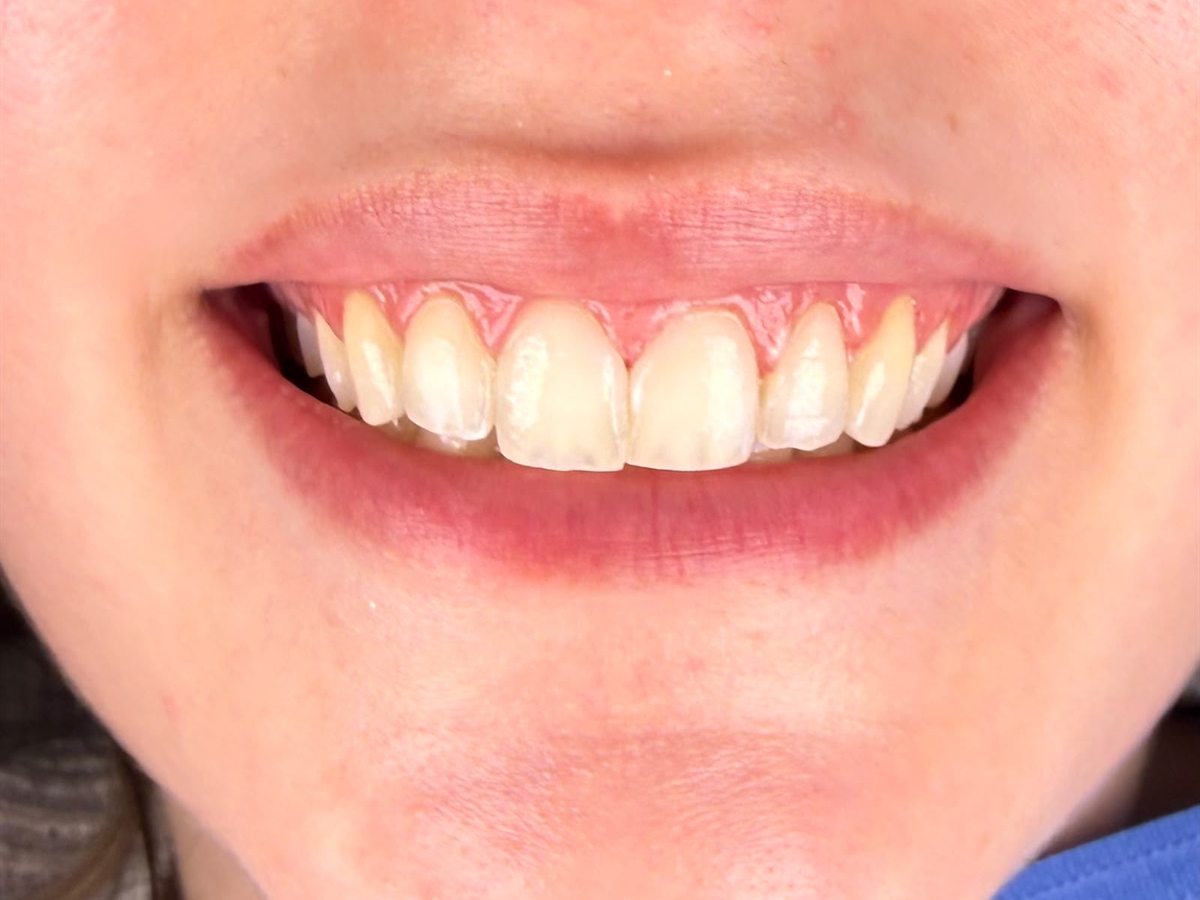
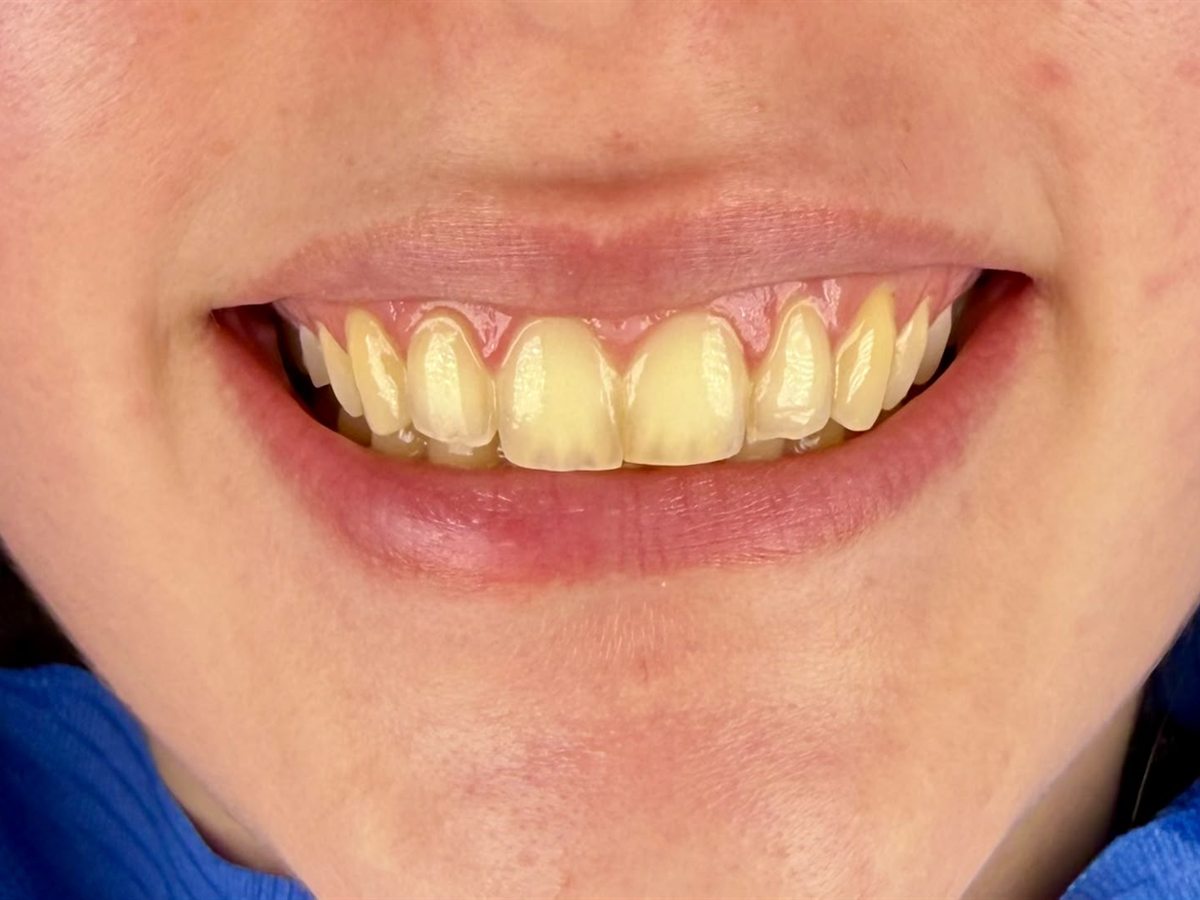
One of our own patients in Beirut, photographed before and after and published with written consent. Drag the handle to compare. More cases are in the before and after gallery.